
Welcome to the Mathematical World!
Marinus of Tyre
Syrian Geographer and Cartographer
Marinus of Tyre (fl. c. 100 CE) was a Syrian geographer and cartographer whose innovations laid the groundwork for the mathematical geography of Claudius Ptolemy. Though none of his works survive directly, his methods and results are preserved in Ptolemy’s Geographia. Marinus introduced systematic cartographic techniques that advanced the precision of geographical science in the Greco-Roman world.
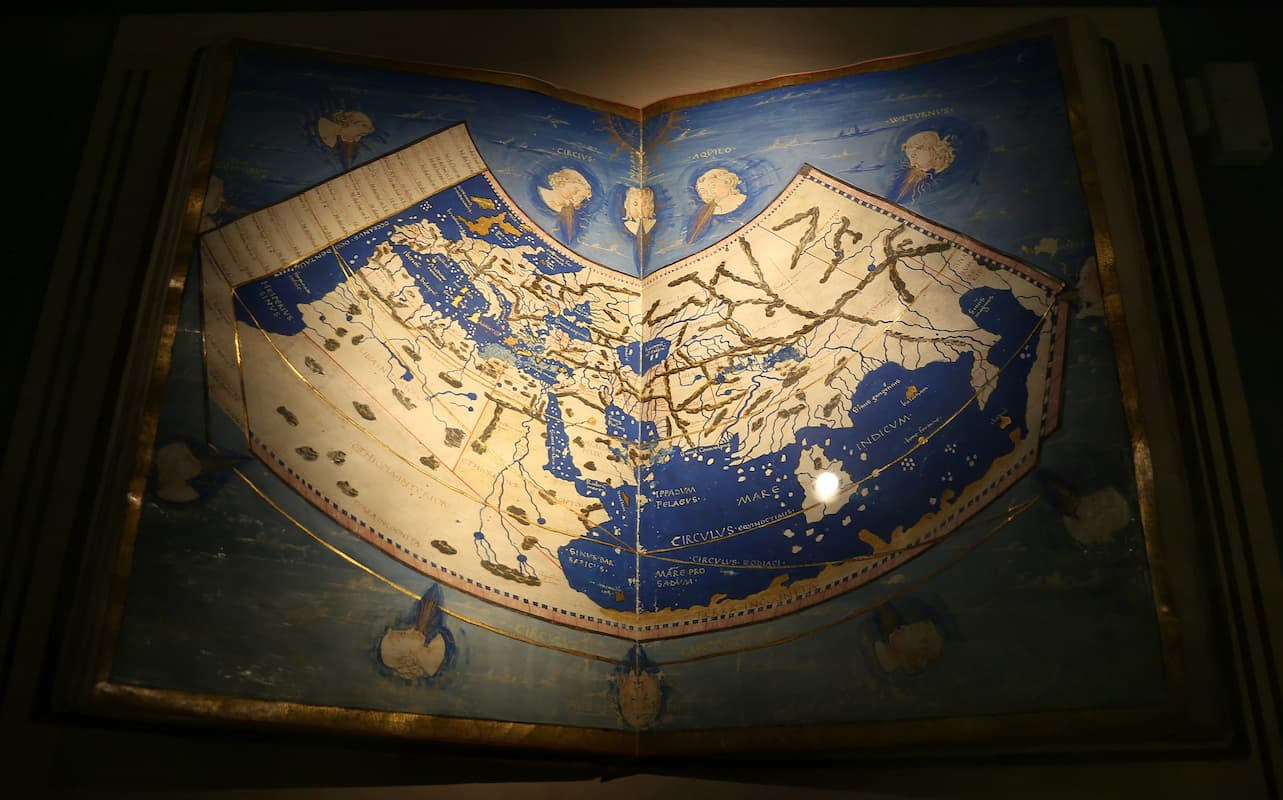
Marinus pioneered the use of a grid system based on latitude and longitude for mapping the Earth’s surface. He defined the prime meridian to pass through the Fortunate Isles (Canary Islands) and measured latitude from the equator. His approach was deeply mathematical: by using astronomical observations to fix latitude and estimating distances for longitude, he created a framework that foreshadowed modern cartography.
Marinus also compiled extensive geographical data from Roman itineraries, travelers, and merchants. He estimated the length of the known world from the Fortunate Isles to the easternmost parts of Asia at 15 hours of daylight, reflecting the use of astronomical parallels for geographical extent. Though his figures often contained errors—particularly in exaggerating the longitudinal span of Asia—they represented an unprecedented attempt to create a consistent mathematical model of the world.
One of his most notable contributions was the concept of a “spherical projection,” in which the curved surface of the Earth was projected onto a flat map. While rudimentary, this marked a turning point in geographical science by acknowledging the geometric problem of representing a sphere in two dimensions.
Marinus’ influence endured through Ptolemy, who explicitly credited him as a predecessor and corrected his errors while preserving his framework. His grid system of coordinates remained the foundation of cartography for centuries, transmitted through the Islamic world into medieval Europe. By integrating mathematics, astronomy, and empirical geography, Marinus of Tyre exemplified the scientific rigor of late antique geography.

All rights reserved by the Mathematical Unity
Contact: +8801400044645
Email: mathematicalhorse1453@gmail.com
Our Discord Server: Mathematical Unity [Ulus Riyadiyat]